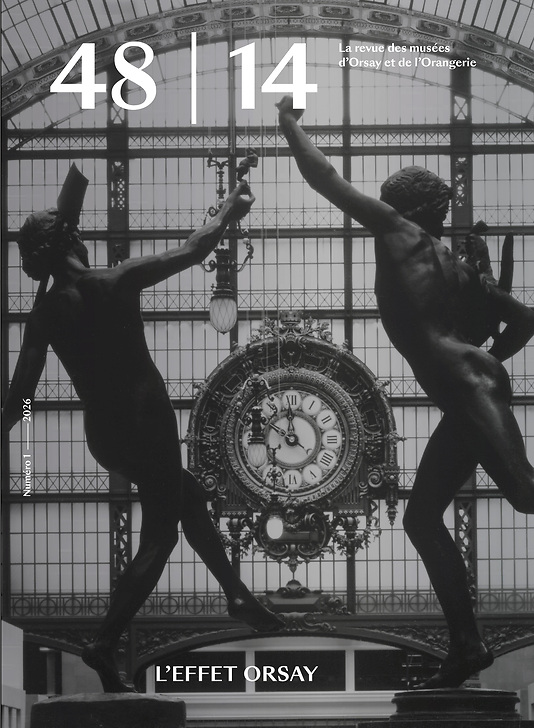
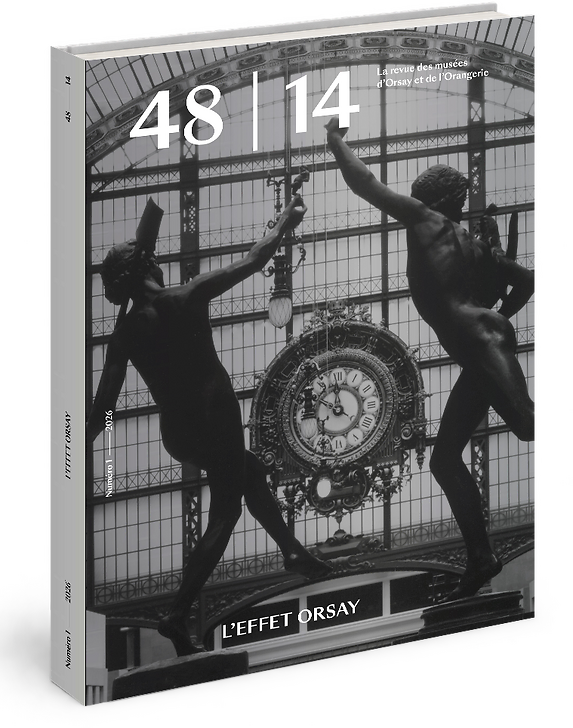
The Orsay Effect: Forty years after it opened in 1986, the Musée d'Orsay is still a project in motion. Born of an unprecedented museographic and scholarly ambition, it has profoundly helped to renew the way we look at the nineteenth century, its artists, its works and their legacy.
To mark this anniversary, the first issue of 48-14. La revue des musées d'Orsay et de l'Orangerie looks back on this adventure and the many debates that accompanied it, examining the "Orsay effect." The museum has made clear choices and opened up new perspectives in many areas: the place given to sculpture, the building of the photography collections, the renewed attention to the so-called pompier painters, the display of architecture, the invention of new forms of cultural outreach, and the rewriting of the narratives of modern art history. Richly illustrated articles and interviews also explore the imaginaries of the nineteenth century and the representations that the Musée d'Orsay continues to inspire. Taken together, these contributions trace the singular dynamic of a place where collections, research, exhibitions and education have never ceased to engage with one another.
https://devisu.inha.fr/48-14
The Orsay Effect: Forty years after it opened in 1986, the Musée d'Orsay is still a project in motion. Born of an unprecedented museographic and scholarly ambition, it has profoundly helped to renew the way we look at the nineteenth century, its artists, its works and their legacy.
To mark this anniversary, the first issue of 48-14. La revue des musées d'Orsay et de l'Orangerie looks back on this adventure and the many debates that accompanied it, examining the "Orsay effect." The museum has made clear choices and opened up new perspectives in many areas: the place given to sculpture, the building of the photography collections, the renewed attention to the so-called pompier painters, the display of architecture, the invention of new forms of cultural outreach, and the rewriting of the narratives of modern art history. Richly illustrated articles and interviews also explore the imaginaries of the nineteenth century and the representations that the Musée d'Orsay continues to inspire. Taken together, these contributions trace the singular dynamic of a place where collections, research, exhibitions and education have never ceased to engage with one another.
With the creation of the Daniel Marchesseau Resource and Research Centre, the Établissement public du musée d'Orsay et du musée de l'Orangerie is reviving 48-14, its scholarly journal dedicated to supporting and disseminating research on the arts of the nineteenth and early twentieth centuries. The journal's name refers to the period covered by the Musée d'Orsay, from 1848 to 1914. Picking up the thread of its history while opening new fields of inquiry, 48-14 aims to offer a fresh perspective on collections and museum practices, and to examine the enduring relevance of the nineteenth century to our present.
A scholarly journal to foster debate in art history
With the revival of 48-14, a journal dedicated to supporting and disseminating research on the arts of the nineteenth and early twentieth centuries, the EPMO reaffirms that research lies at the heart of its mission.
The journal is in step with the ambition of Annick Lemoine, the EPMO's new president, to make Orsay a "museum of debate": a place where interpretations are set against one another, approaches are brought into dialogue, the categories inherited from art history are questioned and research methods are put into perspective.
Bringing together contributions from specialists and interviews with leading figures in the art and cultural world, 48-14 seeks to take part in current scholarship and in the renewal of knowledge. The journal's overall direction and the scholarly review of its contributions are supported by the expertise of a scientific committee and an editorial board. Their membership reflects the range of disciplines involved and ensures excellence in each field.
In this way, the museum affirms its role in producing knowledge and in the exchanges that help advance the understanding of art history.